18 Common Types of Concrete Used in Modern Construction
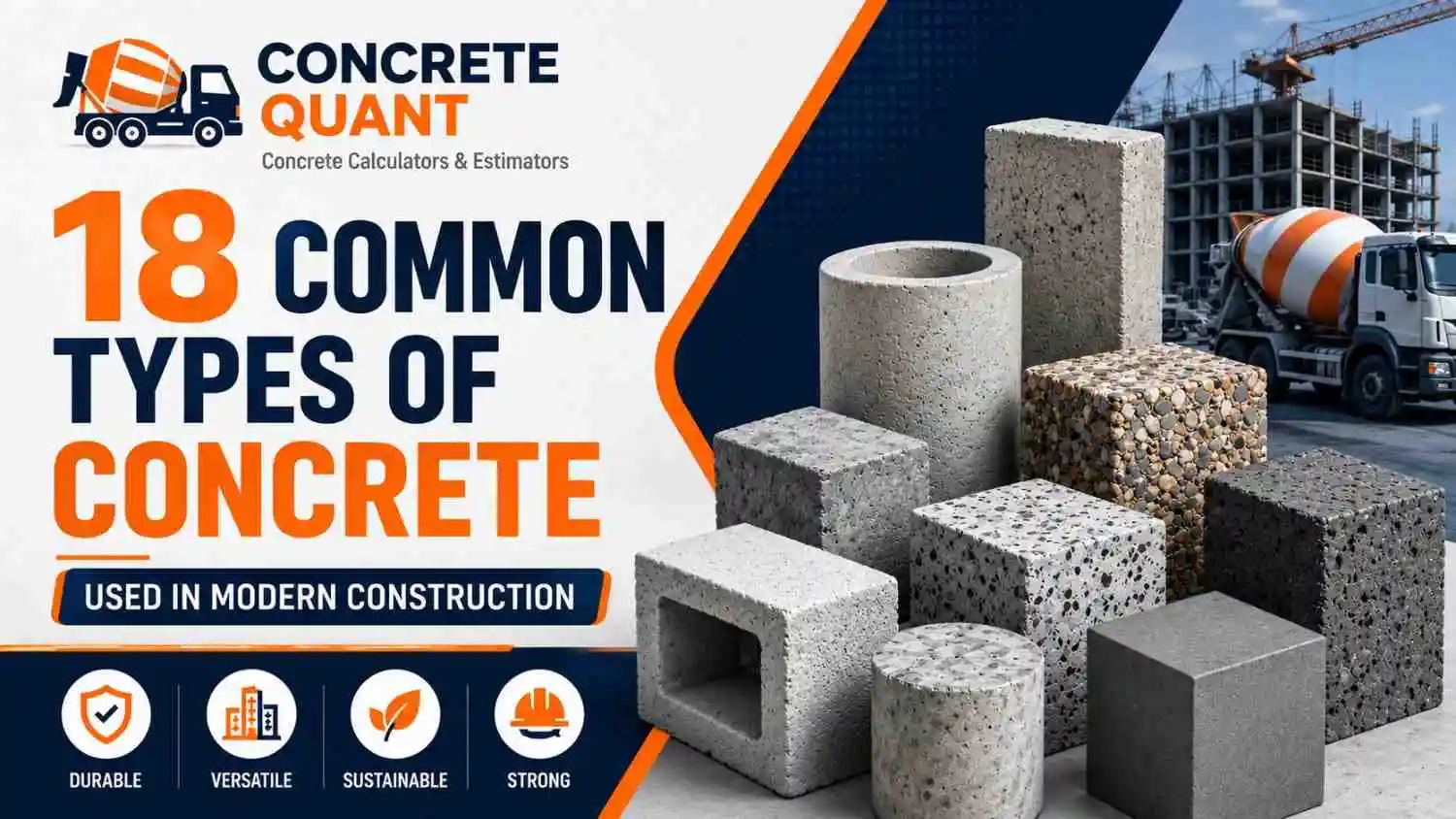
Concrete is one of the most popular construction materials in the world. It is made by mixing cement, water, sand, and aggregates such as gravel or crushed stone. When water reacts with cement (typically Portland cement), it triggers a chemical process called hydration that binds everything together into a hard, rock-like mass. The mixing ratios matter a lot: more cement means stronger concrete, while the water-to-cement ratio controls workability and final strength; too much water weakens the structure. Modern concrete is valued for its strength, versatility, and long service life, making it an essential material in today’s construction industry.
Concrete is not a single material type; it comes in many varieties, each with unique properties and applications. Different projects require different types of concrete — each with its own mix, strength, and purpose.
In this guide, we’ll discuss the 18 most common types of concrete, their uses, advantages, and disadvantages, so you can choose the right one for your project. Before you begin, use our concrete calculator to estimate the exact volume and materials you’ll need for your project.
18 Types of Concrete
1. Plain Cement Concrete (PCC)
Plain cement concrete is the simplest type of concrete. Its mixture contains cement, sand, and aggregate — but has no reinforcement like steel in it.
2. Reinforced Cement Concrete (RCC)
RCC is plain concrete with steel bars (rebar) added inside. The steel handles tension while the concrete handles compression. Contractors use reinforced concrete in large-scale structures like tall buildings, bridges, and dams to provide tensile strength for heavy load-bearing construction.
3. Prestressed Concrete
In prestressed concrete, steel tendons are stretched before the concrete sets. This creates internal compression that counteracts loads.
4. Precast Concrete
Precast concrete is manufactured in a factory and transported to the construction site. This allows for the concrete to be created in a more controlled environment, like a plant or a factory, with more oversight and surveillance, which is good for quality control. Factories can also use the same moulds over and over again, saving time and money.
5. Ready Mix Concrete (RMC)
Ready mix concrete is batched and mixed at a plant and delivered to the site by transit mixers (drum trucks). It usually contains admixtures to make it so the cement doesn’t harden before arriving at the site, and is ready to pour.
Once you’ve chosen your concrete type, check our guide on concrete drying and curing time to plan your project timeline.6. Normal Strength Concrete
Normal-strength concrete is the most common type used in residential construction. It is made by mixing cement, sand, aggregates, and water in standard proportions without any special admixtures or treatments. Mixed in a standard ratio of 1:2:4 (Cement: Sand: Aggregate), having a compressive strength ranging from 20 MPa to 40 MPa.
7. High-Strength Concrete
High-strength concrete has a compressive strength greater than 40 MPa and can exceed 100 MPa. It uses a low water-cement ratio and superplasticisers to improve the flowability and strength of concrete. Compared to normal-strength concrete, the primary use of high-strength concrete is to reduce weight, bleeding, and permeability issues, thereby making the structure more resistant to corrosion and chemical exposure.
8. Lightweight Concrete
This type of concrete uses lightweight aggregates like pumice, expanded clay, or foam. It has a lower density (300–1920 kg/m³) and a higher water content than normal concrete.
9. Heavyweight Concrete
Heavyweight concrete is a type of concrete which uses dense aggregates like barite, magnetite, or iron. Its density can be 3,500 kg/m³ or more.
10. Fiber Reinforced Concrete (FRC)
Fiber-reinforced concrete contains short fibers (steel, glass, polypropylene, or basalt) mixed into it. These fibers control cracking.
11. Self-Compacting Concrete (SCC)
Self-compacting concrete flows and fills formwork under its own weight without vibration. The fluidity in this type of concrete is due to it being made with a higher count of fine aggregate, usually sand, combined with the use of additives like viscosity-enhancing admixtures and superplasticisers, which ensures that the sand particles are dispersed uniformly.
12. Air-Entrained Concrete
In this type, air-entraining admixture (e.g., Fatty Acids, Lignosulfonates) is added during mixing. Millions of tiny air bubbles are uniformly distributed throughout the concrete. Bubble size ranges from 0.1mm to 1mm. Total air content is maintained between 3% to 8%. Bubbles act as pressure relief chambers inside the concrete matrix.
13. Pervious Concrete
Pervious concrete is a special type of open-graded concrete that allows water to pass directly through its surface into the ground below. It is also known as porous concrete, permeable concrete, or no-fines concrete.
This type of concrete is used to build roads and pavements and is designed to manage stormwater runoff, reduce flooding, and recharge groundwater naturally, and can absorb water at a rate of up to five gallons a minute.
Pervious concrete is made by binding coarse aggregate with cement paste, using minimal sand and a low water-cement ratio, to create a porous structure that allows water to pass through.
14. Rapid Hardening Concrete
Rapid hardening concrete gains strength much faster than ordinary concrete. This is because the cement content of rapid set concrete is higher than regular concrete, and also has admixtures added to the mix that work to quicken hydration and the hardening process. It uses special cement like rapid hardening Portland cement.
15. Vacuum Concrete
In vacuum concrete, excess water is removed from freshly placed concrete using vacuum mats. This reduces the water-cement ratio. Mats are placed on filtering pads over the cement, and a vacuum pump is used to extract the excess water. This technique, called vacuum dewatering, lowers the water-to-cement ratio of the concrete, which gives vacuum concrete a higher strength and durability level compared to normal concrete.
16. Polymer Concrete
Polymer concrete replaces cement with polymer resins (like epoxy or polyester) as the binding material. The objective of polymer concrete depends on the type of resin used. Epoxy binders, for example, will aid in less shrinkage during curing, while acrylic binders offer weather resistance and quicker setting times. Polymer plastic is stickier than cement, and therefore, when combined in a concrete mix, it leads to a concrete of higher tensile strength than one composed of Portland cement.
17. Green Concrete
Green concrete is an eco-friendly type of concrete that is produced by using waste materials or industrial by-products as a partial or full replacement for traditional concrete ingredients, reducing carbon emissions and environmental impact. Made by replacing cement partially with supplementary cementitious materials like Fly Ash, Slag, Silica Fume, and Rice Husk Ash. Recycled water is used in the mixing process.
18. Asphalt Concrete
Asphalt concrete is primarily composed of two materials, aggregates (gravel, sand, crushed stone) bound together with asphalt cement (bitumen). It is primarily used for paving surfaces.
For preparation, aggregates are heated and dried, then mixed with hot liquid bitumen at an asphalt plant, transported while still hot, laid down using a paving machine, and compacted by a roller into a smooth, dense surface.
Importance of Selecting the Right Concrete
Choosing the correct concrete type depends on:
- Structural load
- Weather conditions
- Construction speed
- Budget
- Durability requirements
Using the wrong type of concrete can lead to structural failure, increased maintenance costs, and serious safety risks. A well-informed choice up front saves money, extends the structure’s lifespan, and ensures the safety of everyone who uses it.
Conclusion
Choosing the right type of concrete is critical for any construction project. Whether you need strength, durability, speed, or aesthetics, there is a specific type of concrete designed for that purpose.
From simple pathways to complex bridges, every structure deserves the right concrete because the right choice today prevents costly failures tomorrow.